

Table of Contents
ToggleIf you’re planning a big dental treatment, the first question is often about money. Does dental insurance cover implants, and what about Invisalign or veneers?
The short answer is sometimes, often only in part, and it depends on your plan. In Illinois, the type of coverage you have, such as an employer plan, an individual plan, Medicare, or Medicaid, makes a big difference.
This guide explains what’s usually covered, what usually isn’t, and how to find out exactly where you stand. At My Tooth Docs, with offices in Naperville, South Holland, and Bourbonnais, our team checks your benefits before any treatment begins.
How Dental Insurance Usually Works
Most dental plans sort treatments into groups and cover each group at a different level. According to Delta Dental, many plans follow a 100-80-50 structure:
- Preventive care (cleanings, exams, and X-rays): often covered at 100%
- Basic care (fillings, root canals, and extractions): often covered at 80%
- Major care (crowns, bridges, and implants): often covered at 50%
- Orthodontics (braces and Invisalign): included only in some plans, usually with a separate lifetime limit
- Cosmetic treatment (veneers and whitening): rarely covered
A deductible, the amount you pay before your plan starts paying, often applies to basic and major care. Your own plan may use different percentages, so always check your summary of benefits.
Three Plan Rules That Matter Most for Big Treatment
- Annual maximum. This is the most your plan will pay in a plan year. Delta Dental says it usually falls between $1,000 and $2,000, and large treatments can use it up quickly.
- Waiting periods. Delta Dental of Illinois notes that some plans make you wait 6 months for basic care and 12 months for major care, such as crowns or dentures. Most plans you buy on your own, rather than through an employer, have waiting periods.
- Missing tooth clause. Some policies won’t pay to replace a tooth that was already missing before your coverage started.
If you recently switched plans, ask whether your waiting period can be waived. Some plans waive it when your previous dental coverage ended only a short time before the new plan began.
Does Dental Insurance Cover Implants?
Sometimes, but rarely in full. Delta Dental notes that many dental benefit plans help with the cost of implants, but some plans don’t. Here’s what you’ll usually find:
- Some plans cover implants as a major service. They pay part of the cost, often around 50%, after your deductible and up to your annual maximum.
- Some plans exclude the implant itself but still help with related care, such as the extraction, the crown on top, or imaging.
- Some plans have an “alternate benefit” rule. The American Dental Association explains that these plans pay only what they would pay for the least expensive treatment option, such as a bridge or a denture, and you pay the difference.
So, are dental implants covered by insurance? On many plans, yes, partly, but the annual maximum is usually the real limit.
Here’s a simple example with round numbers, not a quote. If your plan pays 50% of a $4,000 implant treatment and your deductible is met, its share would be $2,000. With a $1,500 annual maximum, though, the plan stops at $1,500, and you pay the remaining $2,500.
Because implant treatment often happens in stages over several months, it can sometimes span two plan years. That may let you use two annual maximums, and our team can help you plan the timing.
For a full breakdown of what goes into implant pricing, read our guide to dental implant costs in Naperville. You can also learn about dental implants in Naperville and dental implants in South Holland.
Why Does Dental Insurance Cover Implants Only in Part?
The biggest reason is the annual maximum. In a December 2025 column, the American Dental Association noted that many plans still offer the $1,000 maximum set some 40 years ago, while some now offer $2,000 or more.
Those limits haven’t kept pace with inflation or the cost of care. As a result, a single implant can use up a full year of benefits.
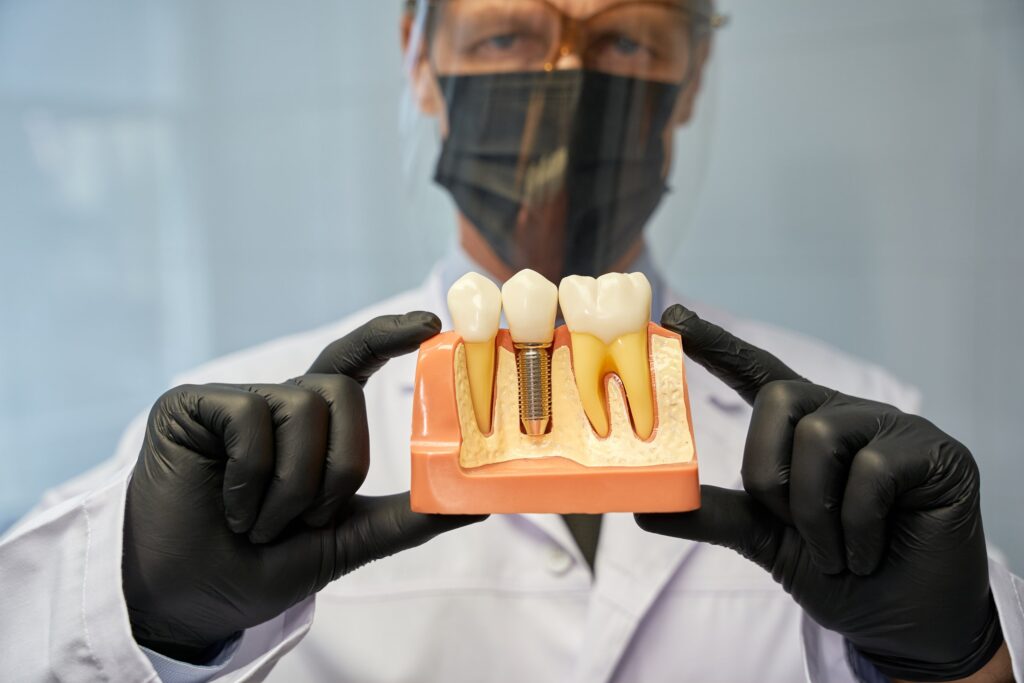
Plans also treat implants as major care, which is paid at a lower percentage and often comes with a waiting period. And if the tooth was lost before your coverage started, a missing tooth clause can rule out the replacement entirely.
Does Medical Insurance Cover Dental Implants?
Usually not. Medical plans generally don’t pay for implants that replace teeth lost to decay or gum disease.
Illinois has an important exception. Under Public Act 103-0972, individual and group health insurance policies issued or renewed on or after January 1, 2026, must cover medically necessary care for a major jaw injury caused by an accident or disease.
That care includes oral and facial surgery, dental implants, crowns, bridges, and orthodontic treatment. Your plan can still apply its usual deductibles and coinsurance.
Not every health plan is regulated by the state, so ask your health insurer whether this coverage applies to your policy. If an accident or a disease such as cancer seriously damaged your jaw, it’s worth the call.
Does Medicare Cover Dental Implants?
Original Medicare (Parts A and B) doesn’t cover most dental care. According to Medicare.gov, that includes dentures and implants in most cases.
Medicare may cover some dental services that are directly tied to other covered medical treatment, such as dental care needed before a heart valve replacement or an organ transplant. Routine tooth replacement isn’t one of them.
Medicare Advantage plans are different. KFF found that 98% of individual Medicare Advantage plans offer some dental benefit in 2026. That benefit may cover only cleanings and exams or may be more comprehensive, and it often has an annual dollar cap.
If you’re a senior with Medicare Advantage, check your plan’s dental summary or call the number on your card. Ask whether implants are covered, how much the yearly dental cap is, and which dentists are in the network.
Does Illinois Medicaid Cover Dental Implants?
No. Illinois Medicaid is run by the Illinois Department of Healthcare and Family Services (HFS), and DentaQuest administers its dental program. The HFS Dental Office Reference Manual states that implants are not a covered service.
Adults age 21 and older can still get important care, including:
- Exams, X-rays, and cleanings
- Fillings and crowns
- Root canals on front teeth
- Extractions
- Complete dentures, once every five years, with prior approval
Partial dentures and bridges are covered only for children under 21. If you’re enrolled in a Medicaid health plan, check its member handbook, because some plans add extra dental benefits, such as partial dentures for adults.
Coverage rules can change, so confirm your benefits with HFS, DentaQuest, or your health plan. It’s also smart to confirm that a dental office is in your plan’s network before you book. To compare tooth replacement options, see our page on full and partial dentures.
Thinking about dental implants?
Does Dental Insurance Cover Invisalign?
It might. Align Technology, the company that makes Invisalign, notes that many dental plans cover Invisalign the same way they cover braces. That only helps if your plan includes orthodontic benefits.
If you’re shopping for dental insurance that covers Invisalign for adults, or checking the plan you already have, look for these details:
- Orthodontic coverage. Does your plan include it at all?
- Age limits. Some plans cover orthodontics only for children and teens.
- Lifetime maximum. Delta Dental explains that orthodontic benefits usually have a lifetime limit that is separate from your yearly maximum. Once you use it, it doesn’t renew.
- Clear aligners. Does the plan cover aligners the same way it covers braces?
- Waiting periods. Ask whether one applies before orthodontic benefits start.
Government programs work differently. Illinois Medicaid covers orthodontic care only for children under 21 who qualify based on medical need and get prior approval, so adults aren’t covered. Original Medicare doesn’t cover routine dental care like orthodontics either.
You can usually use HSA or FSA funds for Invisalign, because orthodontic treatment counts as an eligible expense. To see what affects the price and how payment plans work, read our Invisalign cost guide or learn about Invisalign in Naperville.
Does Dental Insurance Cover Veneers?
Usually not. Veneers are generally classed as cosmetic when they’re used to change the color, shape, or look of healthy teeth, and Delta Dental notes that cosmetic procedures are rarely covered by any type of dental insurance.
There can be exceptions. When a veneer restores a broken or damaged tooth, partial benefits sometimes apply, and in some cases, a plan may cover a crown instead.

HSA and FSA funds generally can’t be used for purely cosmetic treatment under IRS rules. If you’re interested in veneers, learn more about porcelain veneers in Naperville and how they can be planned around your budget.
Coverage at a Glance
Here’s a quick summary of what each type of coverage usually pays for. Original Medicare doesn’t cover any of these in most cases.
| Treatment | Private dental plan | Illinois Medicaid (adults) |
|---|---|---|
| Dental implants | Sometimes, in part | Not covered |
| Invisalign | Only with ortho benefits | Not covered |
| Veneers | Rarely (cosmetic) | Not covered |
| Complete dentures | Often, in part | Covered, with approval |
This is a general guide only. Your actual coverage depends on your specific plan.
How to Find Out What Your Plan Covers
The surest way to avoid surprises is to check before treatment starts:
- Read your plan summary. Look for “implants,” “orthodontics,” “cosmetic,” and “missing tooth” or “pre-existing condition.”
- Call your insurer. Ask about your annual maximum, deductible, waiting periods, and orthodontic lifetime maximum.
- Ask for a pre-treatment estimate. Your dentist can send your treatment plan to your insurer first, so you know what it expects to pay.
- Plan the timing. For treatment done in stages, splitting care across plan years may help you use more of your benefits.
Questions to Ask Your Insurance Company
Keep this checklist handy when you call. The answers tell you what you’ll really pay.
- Are implants covered, and at what percentage?
- Does my plan have a missing tooth clause or an alternate benefit rule?
- How much of my annual maximum is left, and when does it reset?
- Is there a waiting period for major care or orthodontics, and have I met it?
- Does my plan cover orthodontics for adults, and what is the lifetime maximum?
- Are veneers excluded as cosmetic, even when a tooth is damaged?
- Does any of this treatment need pre-authorization?
When Insurance Is Most Likely to Help
Insurance tends to help most when:
- You’ve had your plan long enough to finish any waiting periods.
- The tooth was lost while you were covered, so a missing tooth clause doesn’t apply.
- Your plan includes orthodontic benefits for your age group.
- The treatment restores function, such as a crown on a broken tooth.
It’s least likely to help when:
- The treatment is purely cosmetic, such as veneers on healthy teeth.
- The tooth was missing before your coverage started.
- You’re an adult on a plan that covers orthodontics for children only.
- You have Original Medicare and no separate dental plan.
Ways to Pay for What Insurance Doesn’t Cover
Even with good insurance, most people pay part of the cost of implants, Invisalign, or veneers. A few ways to make that easier:
- HSA or FSA funds. Under IRS rules, these can generally pay for treating dental problems, such as implants, dentures, and orthodontics. Purely cosmetic treatment, such as whitening, doesn’t qualify.
- Monthly payments. We offer Cherry financing so you can spread the cost over time.
- Phased treatment. Some treatment can be done in stages to match your budget and benefits.
At My Tooth Docs, most insurance is accepted. We verify your benefits before you commit, bill your insurance directly, and give you exact written pricing before treatment starts.
Have questions about your plan? Call our Naperville office at (630) 690-1406 (11258 Illinois Route 59), South Holland at (708) 333-2909 (16240 Louis Ave), or Bourbonnais at (815) 939-2012 (482 Brown Blvd), or request an appointment online.
Frequently Asked Questions
Does dental insurance cover implants?
Some plans do, usually as a major service paid at around 50% after your deductible, up to your annual maximum. Others exclude the implant but help with related care, such as the extraction or the crown. Check your plan’s summary of benefits, or ask for a pre-treatment estimate.
What insurance covers dental implants?
Dental plans that cover implants as a major service are the most likely source of help, and some Medicare Advantage plans include dental benefits that may apply. Original Medicare and Illinois Medicaid don’t cover implants. In Illinois, health insurance may also cover implants needed after a major jaw injury from an accident or disease.
Does medical insurance cover dental implants?
Usually not. One exception: Illinois health insurance policies issued or renewed on or after January 1, 2026, must cover medically necessary care, including implants, for a major jaw injury caused by an accident or disease. Ask your health insurer whether your policy is included.
Does Medicare cover dental implants for seniors?
Original Medicare doesn’t cover implants in most cases. Many Medicare Advantage plans include some dental benefits, but they often have a yearly dollar cap, so check your plan’s dental summary.
Does Illinois Medicaid cover dental implants?
No. HFS lists implants as not a covered service. Adults can get complete dentures once every five years with prior approval, along with exams, cleanings, fillings, crowns, and extractions.
Does dental insurance cover Invisalign for adults?
Only if your plan includes orthodontic benefits for adults. Many plans that do will cover Invisalign the same way as braces, up to a lifetime orthodontic maximum. Some plans limit orthodontics to children and teens.
Does Medicaid cover Invisalign for adults in Illinois?
No. Illinois Medicaid covers orthodontic care only for children under 21 who qualify based on medical need and receive prior approval. Adults would need to pay for Invisalign another way, such as with a monthly payment plan.
Does insurance cover veneers?
Usually not, because veneers are generally considered cosmetic. If a veneer repairs a broken or damaged tooth, partial benefits sometimes apply, or your plan may cover a crown instead.