
If you have been told you have an overbite, crowded teeth, or a gap you would like to close, you have probably wondered whether clear aligners can really handle it. So, can Invisalign fix an overbite? In many cases, yes. Invisalign can fix far more than most people expect, including several other bite problems, but not every case.
This guide walks through what Invisalign can fix, how it corrects an overbite, where its limits are, and how to find out whether it will work for your teeth. It is written for patients at our Naperville and South Holland offices, and every answer comes back to the same point: a 3D scan and an exam decide what is possible for your smile.
What can Invisalign fix? The quick answer
Invisalign clear aligners are designed for teens and adults with mild to moderate orthodontic concerns. You may be a good candidate if you have:
- An overbite (deep bite): your upper front teeth overlap your lower front teeth too much
- An underbite: your lower front teeth sit in front of your upper teeth
- A crossbite: some upper teeth sit inside the lower teeth when you bite down
- An open bite: your front teeth do not meet when your back teeth are closed
- Gaps between teeth
- Crowded or crooked teeth
- Relapse after braces: teeth that have shifted since earlier orthodontic treatment
Severe cases, especially those caused by the position of the jaw rather than the teeth, may need braces, surgery, or a combination. That is why the first step is always a proper assessment rather than a guess from a photo.
Can Invisalign fix an overbite?
Yes, in many cases. An overbite, also called a deep bite, is when your upper front teeth cover more of your lower front teeth than they should. Some overlap is normal: according to Invisalign, an ideal bite has the upper incisors covering about a third to a half of the lower incisors. When the overlap is deeper than that, the teeth can wear against each other, and the bite can feel crowded or uncomfortable.
Invisalign corrects an overbite by moving the teeth into a better position, one set of aligners at a time. If some teeth need more significant movement, your plan may include Invisalign attachments: small, tooth-colored shapes bonded to certain teeth that work like handles for the aligners to push on, and they are removed when treatment ends. Your treatment plan maps out each stage of that movement before you start, and Invisalign puts overbite treatment at around 12 to 24 months, depending on the case.
Why it is worth correcting an overbite
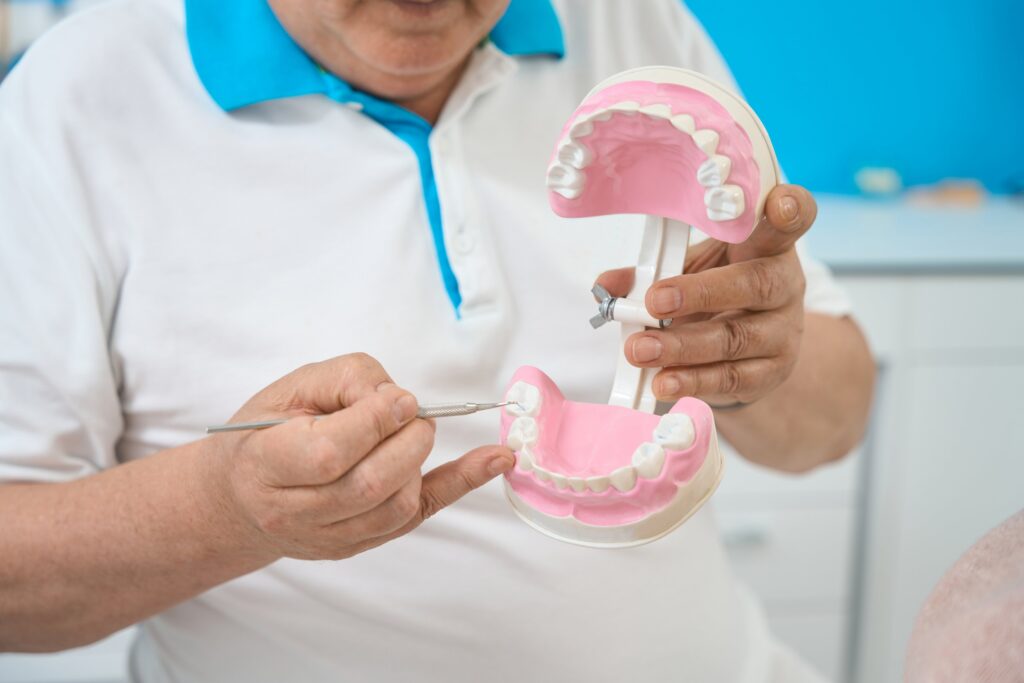
A deep overbite is not only a cosmetic concern. According to Invisalign, correcting one may help prevent problems such as damaged gums, tooth wear and tear, jaw aches and headaches, and difficulty opening your mouth, chewing, or biting. It can also affect speech in some people. If your lower front teeth bite into the gum behind your upper teeth, or your front teeth are wearing down, that is worth mentioning at your next visit.
What an Invisalign overbite before and after really shows
Before-and-after photos can help you picture the change, but every mouth starts from a different place, so someone else’s result is only a rough guide. The comparison that matters is your own. At your consultation, we take a 3D scan with our iTero scanner and design a custom treatment plan around your teeth and your bite.
When an overbite needs more than aligners
If the overbite comes from the jaw itself rather than the position of the teeth, aligners alone may not be enough. Invisalign notes that adult skeletal overbites may require surgery to reposition the jaw. Children and teens are different because their jaws are still growing, which is one reason an early assessment is worthwhile. For some teens, Invisalign also offers aligners with mandibular advancement, which use small precision wings to gradually move the lower jaw forward and improve the bite, so ask at your consultation whether that approach suits your teen’s case.
For a side-by-side look at the two main approaches, read our guide to Invisalign vs braces, including when braces are the better fit for an overbite.
Can Invisalign fix an underbite?
Some underbites, yes. An underbite is when your lower front teeth sit in front of your upper teeth when you close your mouth, and in many cases it happens because the lower jaw sits too far forward. Invisalign states that its aligners can fix some underbites, while severe underbites might require aligner treatment combined with surgery.
It is also one of the harder bites to correct. Cleveland Clinic notes that this type of bite, known as a Class III malocclusion, is often the most difficult type to fix, so an honest assessment matters more here than anywhere else.
Can Invisalign fix a crossbite or an open bite?
Often, yes. A crossbite, where some upper teeth sit inside the lower teeth when you bite, can be treated with Invisalign depending on the type of crossbite, your age, and what is causing it. An open bite, where the front teeth do not touch when the back teeth are together, is also among the cases Invisalign lists as treatable.
For growing children, Invisalign First is designed to guide jaw and arch development and to address issues like crowding, gaps, and narrow arches while the jaw is still developing.
Does Invisalign close gaps between teeth?
Yes. Closing gaps between teeth is one of the problems Invisalign is designed to treat. If the gap between your front teeth is caused by a large frenum, the band of tissue above the front teeth, a minor procedure called a frenectomy may be needed first, followed by treatment such as Invisalign.
Once the gap has closed, retainers keep it that way. Many people wear their retainers full-time for the first few months after treatment and then only at night.
Does Invisalign work for crowded or crooked teeth?
Yes, for mild to moderate crowding. The aligners move your teeth gradually, creating space and bringing them into line. Very severe crowding, or tooth movements that need especially precise control, can be better suited to braces, which is something your consultation will make clear.
If your teeth have drifted since you had braces years ago, Invisalign can often bring them back into position, which suits many adults who want to fix a relapse without going back to brackets and wires.
What Invisalign cannot fix on its own
- Skeletal jaw problems. Severe overbites and underbites caused by the position of the jaw may need surgery alongside orthodontic treatment.
- Some complex tooth movements. Very severe crowding or complex bite problems can be better suited to braces.
- Tooth shape and color. Aligners move teeth; they do not repair a chipped, worn, or stained tooth. Bonding, veneers, or whitening can be planned afterward, as our guide to smile makeovers explains.
- Missing teeth. Invisalign can open or close space, but a missing tooth still needs a replacement, such as dental implants in Naperville or South Holland.
- Results without the wear time. Aligners only work when you wear them 20 to 22 hours a day.
Invisalign at a glance: what it can and cannot fix
| Problem | Can Invisalign fix it? | Good to know |
|---|---|---|
| Overbite (deep bite) | Yes, in many cases | Adult skeletal overbites may need surgery |
| Underbite | Some cases | Severe underbites may need aligners combined with surgery |
| Crossbite | Often | Depends on the type, your age, and the cause |
| Open bite | Yes, in many cases | A 3D scan shows what is causing it |
| Gaps between teeth | Yes | A large frenum may need a frenectomy first |
| Crowded teeth | Mild to moderate | Severe crowding may suit braces better |
| Relapse after braces | Often | Retainers keep the result stable |
How long does Invisalign take?
Invisalign treatment time depends on your case. Most Invisalign treatments at My Tooth Docs take 6 to 18 months, and mild cases can finish in as little as six months. Bite corrections usually sit at the longer end of the range, since Invisalign puts overbite treatment at around 12 to 24 months.
During treatment, you wear your aligners 20 to 22 hours a day and switch to a new set every week or two. You only take them out to eat, to drink anything other than water, and to brush and floss, and you check in with us regularly so we can keep your plan on track.
How much does Invisalign cost?
At My Tooth Docs, the cost of Invisalign is comparable to traditional braces, and nationally, Invisalign treatment typically runs about $3,500 to $8,000 in 2026, depending on the complexity of your case. More complex cases, such as some bite corrections, can take longer, which can increase the cost. We offer flexible monthly payment options, and our guide comparing Invisalign cost with braces breaks the numbers down in more detail.
How to find out if Invisalign will work for you
The only reliable way to know is an assessment. Your Invisalign journey at My Tooth Docs starts with a free consultation, and if you are a good fit, we take a 3D scan with our iTero scanner and design a custom treatment plan. Even if you have been told in the past that you are not a candidate, it is worth asking again, because modern Invisalign technology can treat more cases than ever.

Dr. Bara Abusharara and our team have treated more than 1,275 Invisalign cases across our Illinois offices, and My Tooth Docs is a 2026 Invisalign Sapphire Provider. If you are getting ready to start, our guide to the 5 essential things to know before starting Invisalign covers the practical side.
Frequently asked questions
Does Invisalign fix an overbite permanently?
Invisalign can correct an overbite by moving the teeth, and the result is designed to last. Keeping it depends on wearing your retainers as directed afterward, because teeth can drift over time.
Is Invisalign faster than braces for an overbite?
It depends on the case. Invisalign puts overbite correction at around 12 to 24 months, and braces can be the better choice for complex bite problems. Your consultation will show which approach suits your teeth.
Can adults fix an overbite with Invisalign?
Yes. Invisalign treats overbites in both teens and adults. An adult overbite caused by the jaw itself may need surgery to reposition the jaw, so an exam comes first.
Can Invisalign fix an underbite without surgery?
Some underbites can be corrected with aligners alone. Severe underbites, where the lower jaw sits too far forward, may require Invisalign treatment combined with surgery.
Is Invisalign good for gaps between teeth?
Yes. Closing gaps is one of the problems Invisalign is designed to treat. If a large frenum is causing the gap, a frenectomy may be needed first.
Is Invisalign worth it?
For many teens and adults with mild to moderate crowding, gaps, or bite problems, yes. The aligners are nearly invisible, you can take them out to eat and brush, and most treatments take 6 to 18 months. Whether it is worth it for you depends on your case, which a free consultation will show.
How many hours a day do I need to wear Invisalign?
Plan on 20 to 22 hours a day. Take your aligners out only to eat, to drink anything other than water, and to brush and floss, then put them straight back in.
Do you offer Invisalign for kids and teens?
Yes. Invisalign First is designed for growing children, and Invisalign for Teens gives active teens a nearly invisible alternative to metal braces.
Find out what Invisalign can fix for your smile
A consultation with a 3D scan will show you what Invisalign can do for your teeth and how long it should take. Learn more about Invisalign in Naperville or Invisalign in South Holland.
Call our Naperville office at (630) 690-1406 or our South Holland office at (708) 333-2909 to book your free consultation.