If you are missing most or all of your teeth — or facing the loss of a full arch — the names alone can be overwhelming: All-on-4, All-on-6, All-on-X, zygomatic implants, snap-on dentures, hybrid arches. They are not competing brands you have to pick between. They are points on one spectrum, and the right point for you is decided by your jawbone, not by a sales sheet.
This guide explains what each option actually is, how the All-on-4 vs All-on-6 decision gets made, and what to expect — in plain language, for patients at our Naperville and South Holland offices.
Full-arch implants, in plain language
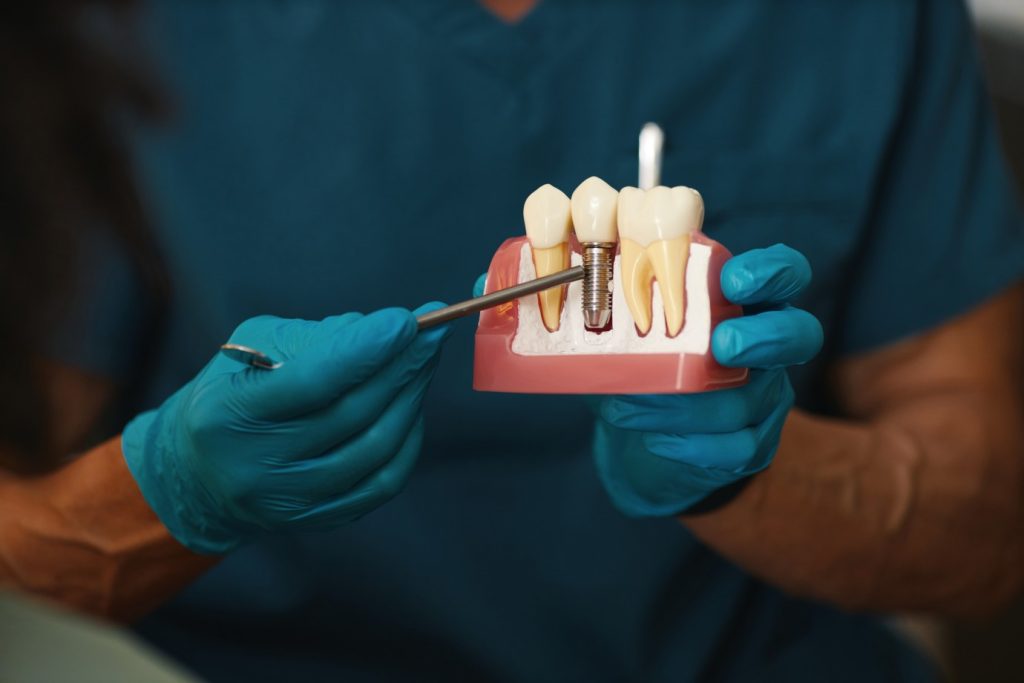
Full mouth dental implants replace a whole arch of teeth — upper, lower, or both — using a small number of implant posts that support one connected set of teeth. Instead of one implant per missing tooth, four to six well-positioned implants can carry an entire arch.
Three things patients often mix up:
- Single dental implants in Naperville (or South Holland) replace one tooth, or a few, with an implant and a crown.
- Traditional dentures are removable plates that rest on your gums, held by suction or adhesive. They can slip, they often cover the roof of your mouth, and the jawbone underneath continues to shrink.
- Full arch dental implants attach to posts anchored in your jawbone, so your teeth stay put — and the bone keeps getting the stimulation that stops it shrinking.
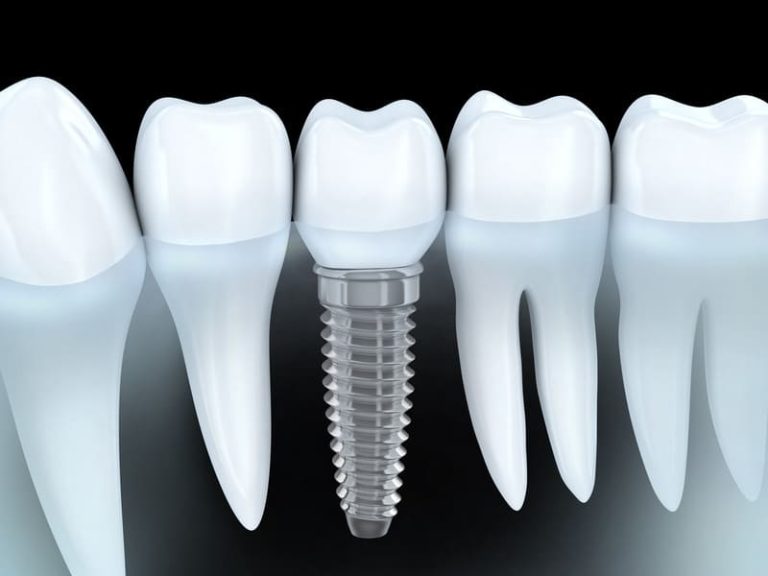
The American Dental Association describes an implant as a post surgically placed in the jaw that functions as a sturdy anchor for replacement teeth, with the bone healing around it in a process called osseointegration. That healing is why a full-arch implant feels solid in a way a denture never does.
What are All-on-4 dental implants?
All-on-4 dental implants use four implants to support a full, fixed arch. Two are placed upright at the front of the jaw, where bone is usually strongest, and two are angled toward the back. That angling is the whole trick: it lets the implants reach solid bone you already have instead of building new bone first, which is why All-on-4 often avoids bone grafting entirely.
All-on-4 is also the treatment that made the phrase “teeth in a day” famous. In suitable cases a temporary fixed arch goes on soon after surgery, and your final teeth are fitted once healing is complete.
What are All-on-6 dental implants?
All-on-6 uses six implants instead of four to carry the same arch. Those two extra posts spread your bite force across more support points, which can suit patients who have enough bone to place them and patients who chew hard or grind.
Not every practice offers All-on-6. We place both, which matters more than it sounds: when a practice only offers one technique, that technique is always the recommendation. Because we do both, the answer comes from your scan.
So what does “All-on-X” actually mean?
Here is the part that trips almost everyone up. All-on-4 and All-on-6 are not alternatives to All-on-X — they are versions of it. “All-on-X” is the umbrella term, where the X stands for however many implants fit your jaw best. Most often that is four or six; occasionally more.
So if you have been comparing “All-on-4 vs All-on-X,” the honest answer is that there is nothing to compare. The real question is how many implants your jaw needs. You can see how we plan these cases on our All-on-X full mouth dental implants page for Naperville or the South Holland version.
All-on-4 vs All-on-6: how the choice is actually made
More implants is not automatically better. Six posts placed into thin bone are weaker than four placed into solid bone. The decision comes down to your anatomy:
| What we look at | Points toward All-on-4 | Points toward All-on-6 |
|---|---|---|
| Bone volume | Limited bone, especially at the back of the jaw | Enough height and width for two more posts |
| Which arch | Often the lower jaw, where bone is denser | Often the upper jaw, where bone is softer |
| Bite force | Average chewing forces | Heavy chewers, clenchers, grinders |
| Grafting | Frequently avoids it | May need minor grafting to create room |
| Surgery and cost | Fewer implants, usually lower cost | More implants, higher cost, more redundancy |
Your gum health, your general health, and smoking all factor in too, because they affect how well the implants heal. None of it can be judged by eye — which is why a 3D scan comes first.
Can you really get teeth in a day?
Often, yes — with one clarification. What goes on the same day is a fixed temporary arch, not your final teeth. It is attached to the implants, you eat and speak and smile with it, and you do not leave without teeth. Your permanent arch is made once your implants have fused and your gums have settled, usually a few months later.
Same-day teeth depend on your implants being stable enough at placement to carry a temporary arch. Some cases qualify and some do not, and your 3D scan tells us which.
Fixed or removable? Hybrid arches vs snap-on dentures
Full-arch implant teeth come in two styles, and this is a genuine choice rather than a clinical verdict:
- Fixed (hybrid arch): permanently attached to your implants. You never take it out; only your dentist removes it for maintenance. It comes closest to natural teeth in feel and chewing power.
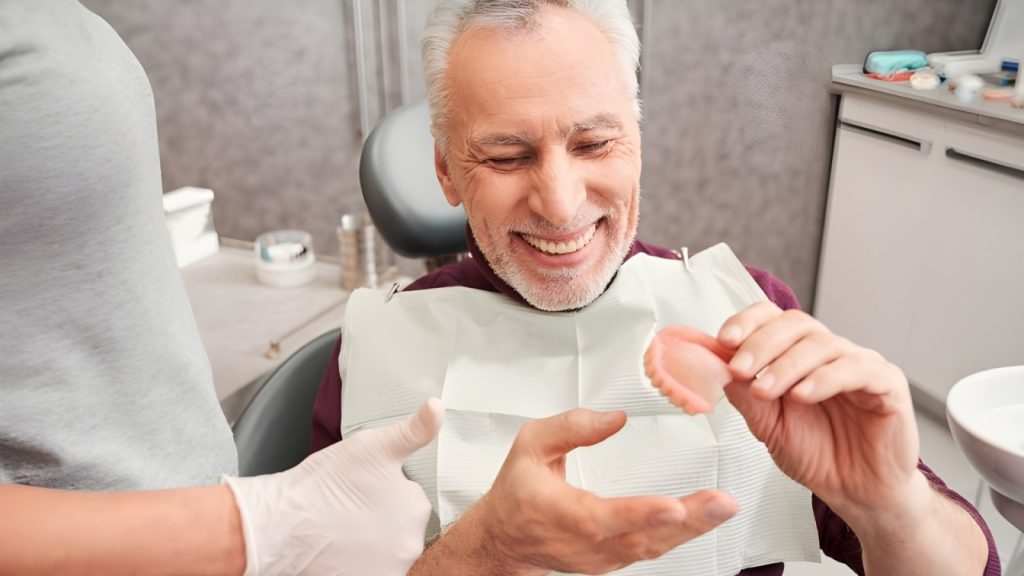
- Removable (implant-supported or “snap-on” dentures): these clip onto your implants for far more stability than conventional dentures, but you take them out to clean. They often need fewer implants and are usually the more affordable route. See our snap-on dentures page for Naperville or South Holland.
The Cleveland Clinic puts it simply: a full arch uses multiple implants, usually four to six, and those implants may support dentures that are non-removable or dentures that snap on and off. The easy way to remember it — snap-on dentures come out, a hybrid arch stays in.
If you are still weighing implants against conventional dentures, our comparison of All-on-X dental implants vs. traditional dentures covers that decision in detail.
What about zygomatic implants?
Sometimes an upper jaw has lost so much bone that even angled implants have nothing to grip. Zygomatic implants are longer implants anchored in the zygoma — your cheekbone — rather than in the upper jaw itself, which can make a fixed arch possible without extensive grafting.
This is a specialized procedure reserved for the most severe upper-jaw bone loss, and it is handled by referral to an oral and maxillofacial surgeon rather than performed here. The great majority of patients never need it. For bone loss short of that, grafting, sinus lifts, and angled implants mean very few people are genuinely out of options — and we do offer those. Your scan is what separates the two situations.
Which full-arch option is right for you?
| Option | Often best for | Fixed or removable? |
|---|---|---|
| All-on-4 | Adequate but limited bone; a fixed arch on fewer implants, often without grafting | Fixed |
| All-on-6 | More bone available; heavier bite forces; extra support and redundancy | Fixed |
| Snap-on (implant-supported) dentures | A stable, easy-to-clean, lower-cost route | Removable |
| Zygomatic implants | Severe upper-jaw bone loss where standard implants are not possible (by referral) | Fixed |
Not sure you are a candidate at all? Our guide on who is a candidate for dental implants is a good starting point.
What the process looks like
Every case differs, but full-arch treatment generally follows the same path:
- Consultation and 3D imaging. We listen first, then take a 3D CBCT scan that maps your jawbone in three dimensions and shows exactly what it will support.
- Planning. Digital implant planning software is used to design where each implant goes before any surgery, and you get an exact, personalized quote with monthly payment options.
- Extractions, if needed. Any failing teeth come out.
- Implant placement. The implants are placed, with computer-guided placement for accuracy. In suitable cases a fixed temporary arch goes on the same day.
- Healing. Over the following months the bone fuses to the implants.
- Your final arch. The permanent teeth are fitted, then checked and adjusted until the bite is right.
What affects the cost of full-arch implants
There is no single price, because no two plans are the same. The factors that move it most:
- How many implants your jaw needs — four, six, or more
- Whether you are treating one arch or both
- The material of the final arch: acrylic hybrid (lighter, generally more affordable) or zirconia (very durable, highly natural-looking)
- Whether extractions, bone grafting, or a sinus lift are needed
- Imaging, sedation, and the provider’s training and experience
In the U.S., dental insurance often covers implants only partially, or not at all. We review your benefits, help you maximize them, and explain Cherry financing for any balance, so treatment can be split into predictable monthly payments. For detailed figures, read our guide to what dental implants cost in Naperville.
Living with your new arch
Full-arch implants restore comfortable chewing and clear speech, end the adhesives, and help preserve the jawbone that dentures leave to shrink. They are built to last, though how long depends on your health, your healing, and your maintenance.
Care is straightforward: brush daily, clean underneath a fixed arch with superfloss or a water flosser, take out and clean snap-on dentures, and keep up with regular checkups so we can monitor the implants and the bite.
Frequently asked questions
What is the difference between All-on-4 and All-on-X?
All-on-4 uses four implants to support a full arch. All-on-X is the umbrella term, where the X is however many implants fit you best — most often four (All-on-4) or six (All-on-6). All-on-4 is a type of All-on-X, not an alternative to it.
Is All-on-6 better than All-on-4?
Not automatically. All-on-6 spreads bite force across more support points, which helps if you have the bone for it or you chew hard. All-on-4 can be the stronger plan when bone is limited, because angled implants reach solid bone and often avoid grafting. Your 3D scan decides it.
How long do full mouth dental implants take?
In suitable cases a fixed temporary arch is placed within a day of surgery. The final arch is fitted once the implants have fused and the gums have settled, typically a few months later.
Are full mouth dental implants removable?
It depends which option you choose. A fixed hybrid arch stays in and is removed only by your dentist. Implant-supported (“snap-on”) dentures clip onto your implants but come out for cleaning.
How much do full mouth dental implants cost?
There is no flat price. Cost depends on the number of implants, whether you treat one arch or both, the materials, and any extractions or grafting. Insurance coverage varies and financing is available. You get an exact, personalized quote at your consultation.
What are zygomatic implants, and do I need them?
Zygomatic implants anchor in the cheekbone and are used only for severe upper-jaw bone loss where standard implants cannot be placed. They are handled by specialist referral, and most patients never need them. A 3D scan tells you whether you are in that group.
Can I get full-arch implants if I have been told I do not have enough bone?
Often, yes. Bone grafting, sinus lifts, and strategically angled implants let us treat patients who were turned away years ago. A 3D CBCT scan gives a definitive answer rather than a guess.
Talk it through at our Naperville or South Holland office
The fastest way to find your option is a consultation with 3D imaging, so the recommendation is built around your bone, your bite, and your budget rather than around a technique. My Tooth Docs provides full-arch implant care at both Illinois offices.
Call our Naperville office at (630) 690-1406 or our South Holland office at (708) 333-2909 to book your consultation.